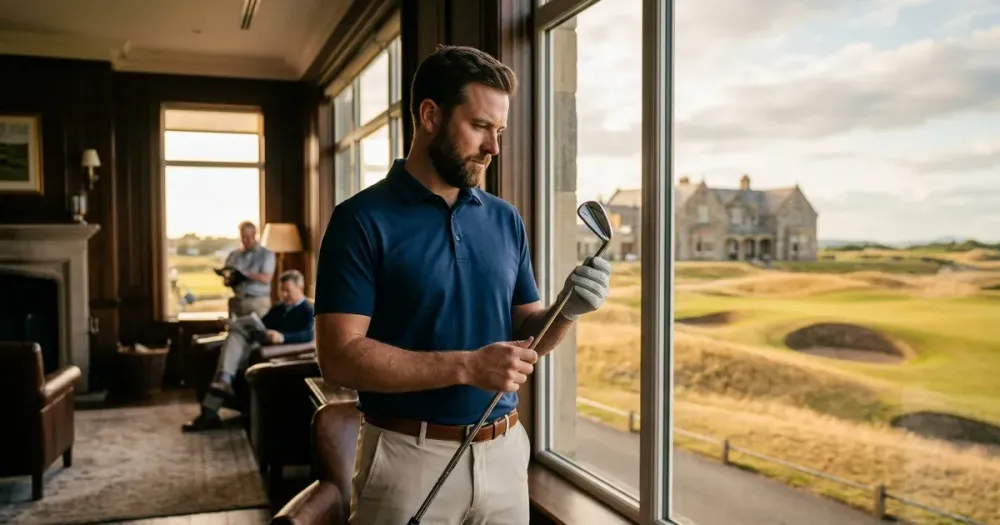
Imagine preparing for one of golf’s toughest challenges by hitting your irons off a cart path. That’s exactly what Collin Morikawa did ahead of the 2026 Open Championship at Royal Birkdale. This unconventional testing method might sound odd—after all, cart paths aren’t the ideal practice surface—but it reveals a sharp focus on how club design interacts with the notoriously firm and fast turf conditions found on links courses. The stakes? Selecting irons that slice cleanly through the ground without digging, a subtle but crucial edge when every shot counts on tight fairways and baked-out turf.
Why Turf Interaction Matters More Than You Think
Links golf is a different animal. Unlike the soft, manicured fairways seen on many PGA Tour venues, the turf at places like Royal Birkdale is firm and unforgiving. Balls often bounce and roll, and the club’s sole must glide through the turf with minimal resistance. Morikawa knew that to compete—and contend—he needed irons designed to handle those conditions. This meant testing not just how the club felt on the swing but how its sole geometry and bounce affected turf interaction.
To simulate those firm conditions at home, Morikawa took an unusual route. Instead of hitting off turf or mats, he struck shots off a cart path. Sounds extreme? According to TaylorMade's tour rep Adrian Rietveld, this provided "an incredibly consistent testing environment." The hard surface made it easy to see exactly where the sole contacted the ground, with every mark offering visual feedback on how the club would behave on firm links turf.
Collin Morikawa Open Championship Iron Testing: The Battle Between P7CBs and P7MCs
Morikawa compared two sets of irons sent by TaylorMade: a custom P7CB set with a unique sole design and leading edge grind, and the P7MC set, famous for its extraordinarily narrow soles. The P7CB was engineered to improve entry into firm turf while maintaining enough bounce to avoid digging too deep. Meanwhile, the P7MC irons have one of the narrowest soles in TaylorMade’s lineup, presenting less bounce and allowing the club to "disappear" through impact for players with Morikawa’s precision.
By hitting both irons off the cart path, Morikawa could assess which sole left fewer marks, indicating cleaner turf interaction. The P7MCs produced fewer marks, confirming they would better slice through Royal Birkdale’s firm fairways with less resistance. This led Morikawa to play a full set of P7MCs (5-PW) at the Open, a move mirroring his winning strategy at Royal St. George’s in 2021.
Why This Method Reveals More Than Equipment Specs
Testing irons by striking off a cart path might seem like overkill, but it highlights how professional golfers obsess over every detail. Turf interaction isn’t just about bounce angles and grind specs on paper. It’s about real-world feel and consistency. For Morikawa, who delivers the clubhead with surgical precision, the difference between a sole that skims the turf and one that digs can mean a shot saved or lost. This method gave him immediate, visual feedback that traditional range practice doesn’t.
It also underscores how equipment choices at The Open go beyond the usual driver and putter conversations. Changing irons for links conditions, especially with sole geometry tailored to firm turf, is a subtle but impactful way pros optimize their chances. TaylorMade’s rep explains that a narrow sole reduces turf resistance, which is vital when fairways are baked hard and the ball often sits down.
Looking Beyond Morikawa: The Broader Trend in Links Golf Equipment
Morikawa isn’t alone in adjusting his bag for links golf’s demands. Recent Open setups have seen players swapping fairway woods for long irons and shifting wedge counts to better suit firm conditions. While some add long irons for precision, others remove them to focus on wedges. This reflects the strategic complexity of links golf where club selection and turf interaction can change the game.
Morikawa’s testing is a textbook example of how equipment and course conditions converge. It’s not just about power or distance but about the finesse of how a club moves through the turf. His success at Royal St. George’s in 2021 and the decision to replicate that approach at Royal Birkdale show a consistent strategy: master the ground game first.
What This Means for Fans and Players
Understanding Morikawa’s iron testing adds a new layer to watching The Open. The choice of irons and how they interact with firm turf can influence shot shape, trajectory, and even course management. It’s a reminder that the equipment battle is ongoing and highly nuanced. For fans curious about golf tips or equipment, it’s a perfect illustration of how professionals tailor gear to specific golf courses and conditions.
In essence, Morikawa’s cart path testing is a window into the meticulous preparation behind the scenes. It shows how a player’s success can hinge on details invisible to the casual observer but vital in major championship conditions.
Looking Ahead: As the Open Championship progresses, all eyes will be on how Morikawa’s setup handles the unpredictable links challenges of Royal Birkdale. Will his narrow-soled P7MC irons provide the clean turf interaction needed to navigate firm fairways and fast greens? The coming rounds will tell if this unusual preparation pays off once again. For a broader view, explore our coverage of golf equipment reviews and buyer guides.
Source: as reported by All The Golf
All facts and quotes are credited to their originating outlets. Learn more about our sourcing policy.