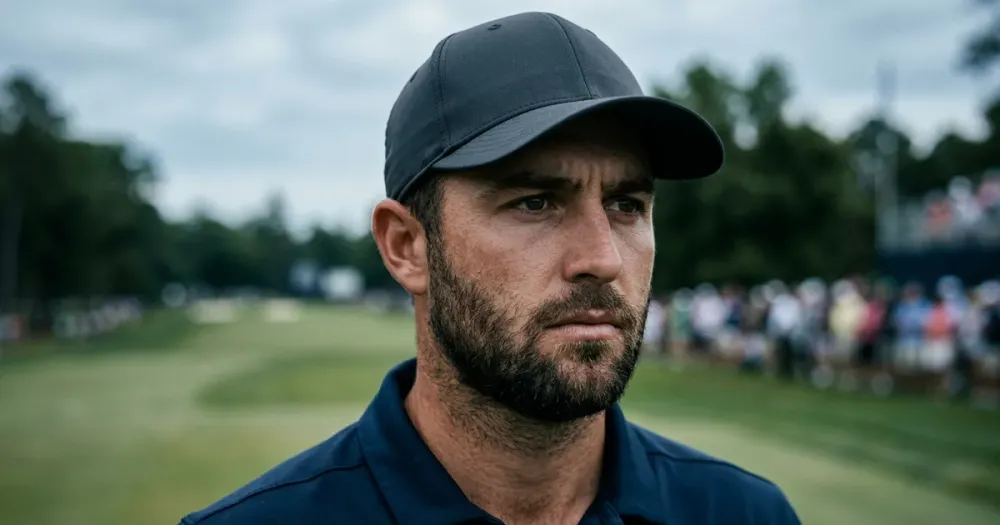
Scottie Scheffler stands at a crossroads few golfers ever reach. On the cusp of potentially becoming just the seventh player to complete the career Grand Slam, he faces a quiet internal battle that few outside golf’s inner circles truly grasp. While the world watches and expects him to chase history at Shinnecock Hills Golf Club, Scheffler himself insists that the Grand Slam isn’t what fuels him. Instead, he’s locked in on something more personal — striving to be the best version of himself amid the relentless pressure that comes with wearing the world No. 1 crown.
Why the Career Grand Slam Isn’t the Real Motivation
Winning the U.S. Open would not just add a major trophy to Scheffler’s collection; it would complete an elite set of the Masters, PGA Championship, Open Championship, and U.S. Open titles. This milestone places golfers like Jack Nicklaus, Tiger Woods, and Rory McIlroy in a rarefied class. Yet, for Scheffler, the chase for this historic feat isn’t the driving force.
“For me, would it be a dream to win the U.S. Open? Of course,” Scheffler said. “But at the end of the day, the Grand Slam has never been a motivating factor for me. I always just wanted to be the best version of myself, and that got me this far.” His words reveal a mindset focused less on external accolades and more on personal growth, a rare perspective in a sport often obsessed with legacy.
The Weight of Expectation and the Reality of Second Place
Scheffler’s recent form underscores the challenge behind his quiet struggle. Since his 20th PGA Tour victory at The American Express in January, he has yet to secure another win, despite multiple close calls. His record shows three runner-up finishes and seven top-five placements in 11 starts, with consistent top-25 results in every outing. Yet, the sting of not crossing the finish line first lingers.
“Golf is such a funny game,” Scheffler reflected. “If I finish second this week, it’s almost like, 'Hey, you failed in your first chance to win the career Grand Slam.' Is finishing second a failure? It can feel that way, but I think sometimes when you look at more from a wider view of the sport and where your game’s at, second is not always that bad. But man, does it frickin’ hurt at the same time.”
This tension between achievement and perceived failure is the emotional core of Scheffler’s journey. It reflects the brutal mental game golf demands, where the margin between triumph and heartbreak is razor-thin.
Elite Status Amid the Struggle: A Comparison to Tiger Woods
Scheffler’s status as world No. 1 during majors adds another layer to his narrative. He has now competed in 13 consecutive majors holding that top ranking — a streak second only to Tiger Woods, who recorded 21 straight from 2005 to 2010 and 20 in a row from 2000 to 2004. No other golfer has matched double-digit consecutive majors as the world’s best.
This statistic highlights Scheffler’s place among golf’s modern elite. Yet, his recent struggles remind us that even the very best wrestle with form and confidence. His slow starts have been a hurdle; his first-round scoring average is notably higher than his final-round average. Sharpness, he admits, has been elusive.
“I feel like I’ve been close most of the year,” Scheffler said. “I feel like I just haven’t been as sharp as I needed to be. I think the margins in this game are so small. For me to be winning a lot of tournaments, you’ve got to just be really, really sharp. I feel like maybe I’ve just been a touch dull.”
What This Means for Scheffler’s Quest and Golf Fans
Understanding Scheffler’s mindset adds depth to his U.S. Open campaign beyond the headline of a Grand Slam chase. It reveals the human side of an athlete under immense pressure, grappling with expectations and the fine line between success and disappointment. This perspective also explains why his focus stays on process over milestones — a subtle but crucial distinction that shapes how he prepares and performs.
For golf fans, this means the story at Shinnecock is about more than historic achievement. It’s about witnessing a world No. 1 navigating the mental complexities of the sport’s biggest stage while managing personal standards that may be tougher than any leaderboard challenge.
Looking Ahead: Scheffler’s Next Test
As Scheffler moves forward, his ability to sharpen his early-round performance will be critical. The U.S. Open is notorious for testing every facet of a player’s game, and starting strong could make the difference between contending and fading. Observers will want to watch not just his scorecard but how he handles the psychological pressures that come with elite status and rare opportunities.
Whether or not Scheffler completes the career Grand Slam, his journey this week offers a compelling glimpse into the psychological battle at the heart of professional golf.
According to All The Golf, this nuanced view of Scheffler’s mindset breaks down the myth that chasing history is always the main motivator for top players. Instead, it underscores how personal standards and mental resilience often dictate performance at the highest level. For a broader view, explore our coverage of golf majors coverage and results.
Source: according to All The Golf
All facts and quotes are credited to their originating outlets. Learn more about our sourcing policy.