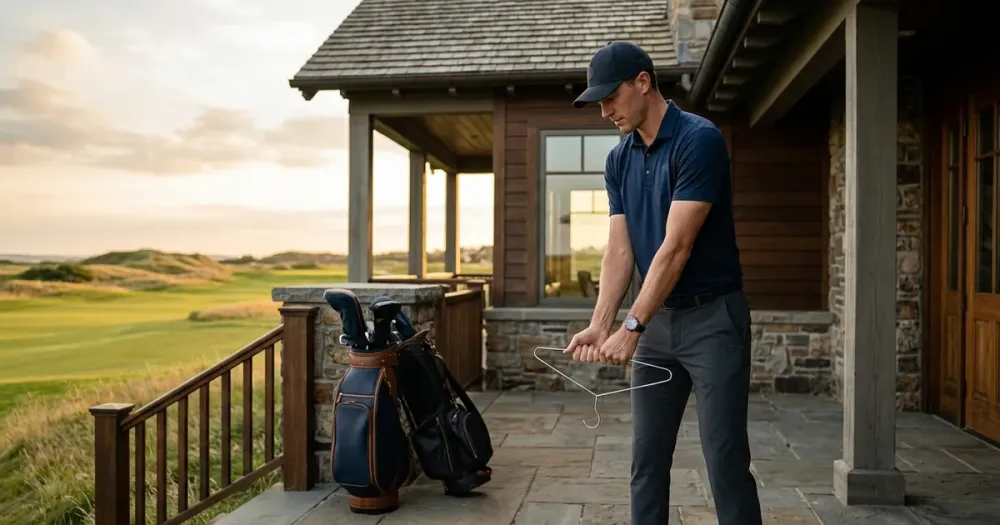
On the Monday before The Open Championship at Royal Birkdale, Wyndham Clark caught the attention of onlookers—not with a golf club, but with a simple coat hanger gripped in his hands. This unconventional tool raised eyebrows across the media and among fans, prompting questions about its purpose. Clark, however, was clear: the coat hanger is a deliberate training aid to correct a subtle flaw in his swing that has been undermining his ball striking.
How a Coat Hanger Became Part of Clark’s Practice Routine
Clark’s use of a coat hanger wasn’t a whimsical choice. Rather, it is the latest iteration of a drill designed to restore proper lead wrist flexion. Under the guidance of swing coach Pat Coyner, a recognized GOLF Top 100 Teacher, Clark identified that his left wrist had gradually become over-extended in his swing. This subtle extension opened the clubface at impact, making it harder to control and leading to inconsistent ball flight.
The conventional solution might have been to overhaul the swing, but Coyner’s approach focused on restoring structural integrity to Clark’s wrist position. The coat hanger acts as a lightweight, rigid reminder for Clark to maintain the correct wrist angle during his swing. Clark described the drill succinctly: "The coat hanger is for wrist angle, trying to get a little more flexion in my left wrist so I can square the face more." This feedback loop helps reinforce the feeling needed to square the face consistently.
Why Wrist Position Matters More Than It Appears
In golf, the lead wrist plays a pivotal role in controlling the clubface through impact. Even minor deviations can cause the face to open or close, dramatically affecting shot accuracy and trajectory. Clark’s over-extended wrist had forced him into compensations that resulted in unpredictable start lines and a frustrating two-way miss pattern.
By targeting the wrist angle specifically, Clark and Coyner are addressing the root cause rather than the symptoms. The coat hanger drill simplifies the complex biomechanical challenge of feeling and maintaining that subtle flexion. It’s a classic example of how professional golfers use creative, personalized tools to fine-tune their mechanics beyond traditional club-based practice.
What Clark’s Drill Reveals About Practice Innovation in Pro Golf
Clark’s coat hanger drill drew considerable attention, partly because it’s unusual to see a non-golf object employed in elite practice sessions. Yet, this choice underscores a broader trend of innovation and experimentation among top players. Rather than relying solely on traditional methods, pros are increasingly embracing customized tools and drills that target specific mechanical issues.
Such inventive approaches reflect the fine margins in major championship preparation. At this level, even incremental improvements in swing repeatability can translate to significant competitive advantages. Clark’s drill is a tangible reminder that elite golf performance often depends on creative problem-solving and adapting training techniques to individual needs.
Looking Ahead: Will the Drill Pay Off Under Pressure?
Clark’s ball-striking challenges at the Genesis Scottish Open motivated this adjustment, and The Open Championship provides the stage to test its effectiveness. As he tees off alongside Cameron Young and Ludvig Åberg, all eyes will be on whether the restored wrist flexion leads to cleaner, more consistent contact.
Ultimately, the success of this unconventional practice aid will be measured not by its novelty but by its impact on Clark’s scores and shot-making in one of golf’s toughest tests. His use of the coat hanger highlights how even the simplest tools can play a crucial role in refining elite-level skills.
According to All The Golf, Clark’s coach Pat Coyner emphasized that the drill’s goal is to reinforce wrist angle, a key to squaring the clubface, rather than forcing a swing overhaul. This focus on precise mechanical correction through unique training aids may offer insights for other players facing similar technical hurdles.
Why the Wyndham Clark Coat Hanger Practice Open Championship Drill Matters
This drill is more than a curiosity; it’s a window into the high-stakes world of major championship preparation where every detail counts. The coat hanger serves as a physical cue to build muscle memory for a critical wrist position, helping Clark avoid the inconsistent ball striking that cost him in previous tournaments.
For fans and aspiring players, this episode illustrates how innovation in golf practice isn’t limited to advanced technology or high-end equipment. Sometimes, the key to fixing a complex swing issue comes from the most unexpected places—even a humble coat hanger.
What this means is that elite golfers are continually searching for tactile feedback tools that help them internalize subtle biomechanical adjustments. Why it matters is that these small refinements can make the difference between contention and missed cuts. How it works is by converting a fleeting sensation into a repeatable motion, a cornerstone of consistent performance.
What to Watch Next
The immediate test for Clark’s coat hanger drill comes as The Open Championship unfolds at Royal Birkdale. His tee time alongside Cameron Young and Ludvig Åberg will provide the first real indicator of whether the restored wrist flexion translates into improved ball striking under major championship pressure. Observers should watch for changes in Clark’s shot dispersion and clubface control, which could signal that this unusual drill is more than a gimmick—it’s a strategic edge. For a broader view, explore our coverage of golf majors coverage and results.
Source: according to All The Golf
All facts and quotes are credited to their originating outlets. Learn more about our sourcing policy.