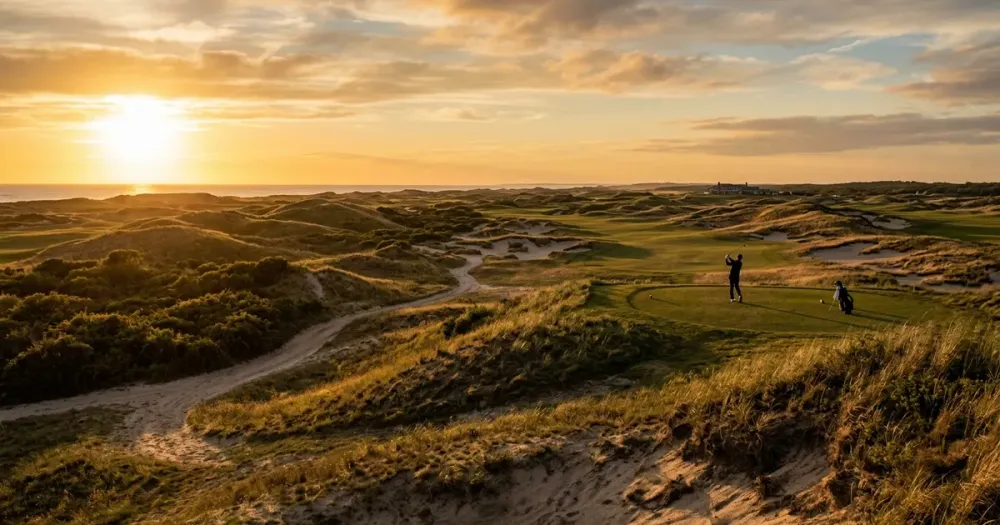
The afternoon sun blazed over Shinnecock Hills, but the heat wasn’t the only pressure bearing down on Wyndham Clark. From the opening tee shot of the final round, the gallery’s hostility was unmistakable. Cheers for his opponent Scottie Scheffler quickly turned into jeers aimed squarely at Clark. “Crash and burn, Wyndham!” echoed from the luxe Founder’s Club, a rare and unsettling sound for a major championship leader. It was a scene as much about mental warfare as the brutal links course itself.
Clark, holding a commanding six-shot lead after 54 holes at the 126th U.S. Open, faced not just a challenging Shinnecock layout but a gallery that seemed determined to see him falter. This wasn’t simply rooting for Scheffler’s bid to complete a career Grand Slam on his 30th birthday; it was an unusual collective effort to unnerve the frontrunner. Fans yelled for his approach shots to find bunkers and encouraged his mistakes. Security had to remove hecklers. Yet Clark remained poised, navigating the emotional and physical gauntlet with an inner toughness few could match.
The Mental Gauntlet: Not Just a Course Challenge
Shinnecock Hills is infamous for demanding precise shot-making and relentless strategic discipline. But the gallery’s unrelenting heckling added a layer of adversity rarely seen in U.S. Open final rounds. Clark’s bogeys on holes 2, 5, and 7 coincided with the crowd’s vocal antagonism, yet he refused to unravel. “It’s brutal,” said a volunteer observing the jeers. Yet Clark’s response was to replace negativity with positive focus, a mindset sharpened by years working with mental-game coach Julie Elion. After enduring similar pressure moments in previous majors and international team events, Clark knew how to steady himself when the stakes soared.
His preparation went beyond physical practice; it was psychological resilience. Clark joked with his caddie David Pelekoudas whenever he heard a rare cheer, acknowledging how isolated he felt amid the crowd’s hostility. But this was familiar territory. Earlier in his career, Clark had faced public scrutiny for rules controversies and moments of frustration, including a club toss at the 2025 PGA Championship. The fallout lingered, contributing to his underdog status despite his obvious talent.
Squandered Lead, Steely Resolve
Despite the six-shot cushion, Clark’s margin evaporated quickly on Sunday. A front-nine 38 dropped him to four under, while Sam Burns surged with a 67 to set the clubhouse lead at three under. Clark’s birdie on 10 and a dramatic 25-foot putt on 16 stretched his lead again, but a messy three-putt bogey on 17 tightened the finish. The tension was unmistakable as Clark teed off on 18 needing a par 4 to clinch the title.
The gallery, now quieter and thinning, watched as Clark’s approach landed short of the green but safely on the front edge. With two putts to win, his nerves showed briefly before the birdie try nestled to 9 inches. The tap-in sealed a second U.S. Open title, cementing his place among resilient champions forged by pressure and adversity.
Why This Wyndham Clark U.S. Open 2026 Win Story Matters
This victory is not just about a trophy. It’s a testament to mental toughness amid relentless external pressure. Clark’s ability to maintain focus and execute under hostility reshapes the narrative of major championship battles, where often the crowd’s mood can sway momentum. His journey from public criticism to major champion highlights the importance of psychological preparation in golf’s highest stakes.
Moreover, Clark’s win at Shinnecock Hills adds a compelling chapter to U.S. Open history, where course difficulty and player grit have long intertwined. His experience shows that even at the most punishing courses, it’s the mental game that often decides the outcome.
From Colorado Underdog to Major Champion
Clark’s path to this moment has been anything but smooth. Rising from a relatively unknown player in 2023 to a two-time U.S. Open champion, his story is one of perseverance. His partnership with mental-game coach Julie Elion and steady performances in events like the CJ Cup Byron Nelson and the RBC Canadian Open prepared him for this ultimate test. Clark’s ability to thrive under pressure, even when the crowd is against him, distinguishes him in a sport where the margin between triumph and collapse is razor-thin.
What to Watch Next
With this landmark victory, all eyes turn to Clark’s next challenges. How he carries this resilience into upcoming majors and international events will be revealing. The pressure to defend a U.S. Open title, especially after a dramatic final round, is immense. The next ranking updates and Ryder Cup selections will also test whether Clark can maintain his mental edge on golf’s biggest stages.
His journey at Shinnecock Hills is a vivid reminder: in golf, the fiercest battles often happen off the scorecard, where grit and resolve define champions. For a broader view, explore our coverage of golf majors coverage and results.
Source: as reported by All The Golf
All facts and quotes are credited to their originating outlets. Learn more about our sourcing policy.