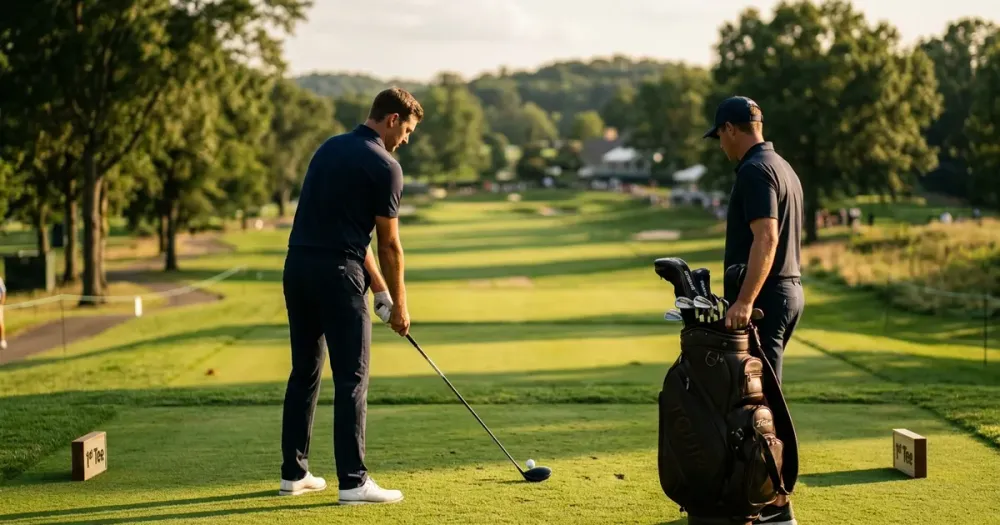
On a crisp Thursday morning at East Lake Golf Club, Adam Scott stepped up to the first tee and unleashed a performance that felt both familiar and remarkable. At 46, the Australian shot a sparkling 66 to open the 2026 Tour Championship, signaling that he’s far from done in a sport that often feels dominated by youth. This moment wasn’t just about a strong round; it was a vivid reminder that experience and resilience remain potent forces amid golf’s rapidly shifting landscape.
Scott’s opening salvo has deeper meaning. Two decades after his first Tour Championship victory at the same venue, he’s once again in the mix among the world’s elite. The stakes are high: a potential 15th PGA Tour win, a historic second Tour Championship title, and a chance to claim the FedEx Cup—a milestone that has eluded him so far. But beyond personal glory, Scott’s presence underscores a larger story about how professional golf is evolving.
Adam Scott Tour Championship 2026: A Testament to Longevity and Adaptation
When Scott defeated Jim Furyk at East Lake in 2006, the PGA Tour was a different beast. The FedEx Cup was still in its infancy, and the Tour’s postseason format would undergo multiple transformations in the years to come. Now, with plans already in motion to overhaul the postseason by 2028, Scott’s ongoing competitiveness bridges eras in golf history.
“The learning curve is a lot quicker,” Scott said after his opening 66, reflecting on how today’s emerging stars arrive more battle-ready than ever before. He credited recent generations, starting with Jordan Spieth, for coming onto the Tour with a polished game thanks to improved college programs and better preparation. “I probably took for granted those years where I was kind of cruising through out here,” Scott admitted. “The moment I relax, I just plummet down the rankings and leaderboards.”
The Deepening Pool of Talent and Scott’s Enduring Edge
Scott’s insight reveals a critical shift: the PGA Tour now features a deeper and more competitive field. Gone are the days when rookies needed years of apprenticeship to contend. Today, young players arrive ready to contend immediately, making the margin for error razor-thin for veterans.
Yet Scott’s sustained excellence, from his Masters win in 2013 to consistent top finishes in recent seasons, highlights how adaptability and work ethic remain invaluable. He’s not just hanging on; he’s a contender again, evidenced by his 12-under total after three rounds in 2026, trailing the leader by just three strokes.
Evolution of the Tour Championship and Its Broader Significance
The Tour Championship itself has transformed alongside the sport. Where Scott’s 2006 win earned him $1.17 million, this year’s prize for the winner is a staggering $10 million, reflecting golf’s burgeoning financial scale. Beyond money, the tournament is a bellwether for the shifting power dynamics on the PGA Tour, especially with the FedEx Cup’s impending retirement and the introduction of a new match-play format in 2028.
Scott’s quest to become the oldest Tour Championship winner ever, surpassing the 43-year-old Mark McCumber’s 1994 record, adds historical weight. His performance is a touchstone for discussions about career longevity in an era where physical fitness, technology, and data-driven coaching redefine how players maintain peak form.
Mindset and Work Ethic: Keys to Competing in Modern Golf
Scott’s reflections reveal the mental demands placed on veterans. “There’s no letting up out here,” he said. Maintaining elite status means relentless preparation and focus, especially against a backdrop of younger, technically advanced competitors. Scott’s ability to sustain his ball-striking prowess amid these pressures is a testament to his professionalism and passion for the game.
His career trajectory also spotlights the balance between experience and innovation. While younger players benefit from advanced training and analytics, Scott’s blend of refined technique and competitive grit keeps him in contention. It’s a nuanced battle where adaptability can trump raw talent alone.
What This Means for Golf Fans and the Tour’s Future
Adam Scott’s Tour Championship 2026 campaign illustrates more than one player’s revival; it reflects the evolving nature of professional golf itself. The game is faster, the competition more intense, yet there remains room for seasoned champions to shape the narrative. Scott’s story invites fans to appreciate golf’s blend of tradition and transformation.
For those following the Tour’s postseason drama, Scott’s performance is a compelling subplot that bridges past and future. As the PGA Tour prepares for sweeping changes in 2028, players like Scott embody the sport’s enduring spirit amid uncertainty.
Looking ahead, all eyes will be on Sunday’s final round at East Lake, where Scott hopes to crown his resilience with a victory that defies age and evolution alike. Whether he clinches the title or not, his presence at the top of the leaderboard is a powerful reminder: in golf, mastery is a marathon, not a sprint.
Next up, the PGA Tour will shift focus to its new postseason format, testing not only the mettle of rising stars but also the staying power of veterans like Scott. Fans should watch closely how this transition impacts player dynamics and the quest for major milestones like the FedEx Cup. For a broader view, explore our coverage of PGA Tour news and results.
Source: as reported by All The Golf
All facts and quotes are credited to their originating outlets. Learn more about our sourcing policy.