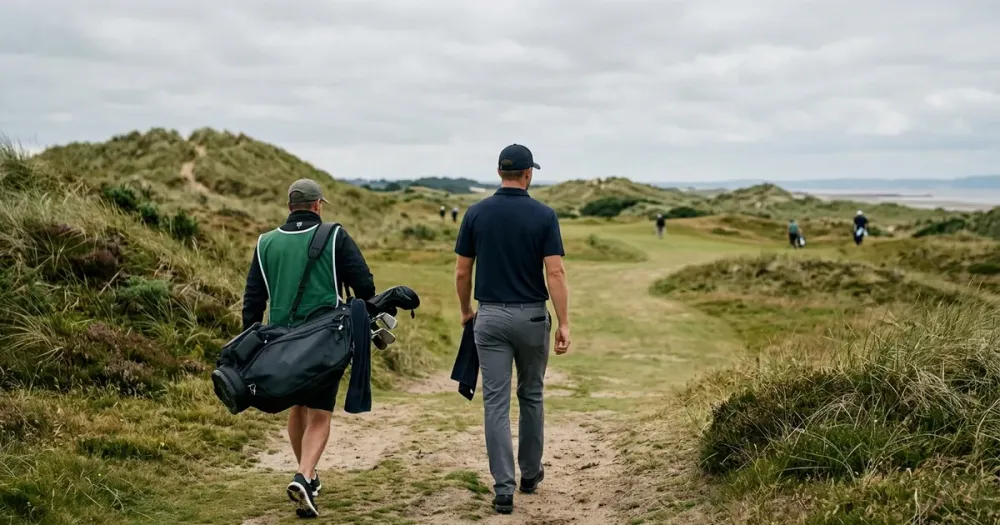
The air was thick with tension on Royal Birkdale's 18th green as Ryan Fox, moving at a breakneck pace, readied himself for what would become a defining putt. His playing partners barely had time to catch their breath. Sam Burns had just holed out, clearing the stage, and in a swift 22 seconds—less than half the usual pause at such a moment—Fox set his ball rolling toward victory. The rapid-fire rhythm was more than a quirk; it unsettled the group’s tempo and spotlighted a radical way to approach professional golf.
Scottie Scheffler, who shared a group with Fox and Zecheng Dou at the Phoenix Open earlier this year, captured the feeling best: "We walk off the 9th tee, and he goes, ‘Foxy, it doesn’t even feel like you’re in the group,’” Scheffler said. “It just feels like we’re playing in a two-ball, you hit it so fast. It’s just in the air.” That stark contrast to the typical deliberate pace on tour raised a question: could Fox’s rapid approach be more than personal style—could it be a competitive edge?
Ryan Fox’s Speed: A Strategy Born from Multi-Sport Agility
Fox’s swift movement on the course is no accident. Growing up in Auckland, New Zealand, he developed a quick decision-making ability not only on the golf course but also on cricket pitches and tennis courts. He credits his father, Grant Fox, a rugby legend, for instilling a no-waste-of-time approach during corporate golf outings. "I need to make sure this comes across right," Ryan said. "It’s not that difficult to pick a shot and pick a club. It’s always going to be between one or two clubs into a green, and I just see the shot quickly, pick a shot quickly, and the less time I have to think about it, the less bad stuff can creep in there."
This instinctive style reduces overthinking and limits the mental noise that often leads to mistakes. In a sport where many players take painstaking time over even mid-range shots, Fox's method challenges the prevailing wisdom that more deliberation equals better results.
Speedgolf’s Christopher Smith Validates the Benefits of Fast Play
Watching Fox’s final round from Eugene, Oregon, was Christopher Smith, a GOLF Top 100 Teacher and Guinness World Record holder for speedgolf. Smith’s own record-setting 65 in 44 minutes at the Chicago Speedgolf Classic in 2005 demonstrates the performance benefits of brisk play. "One of the ways I—and people can test themselves—is timing them from the moment they address the ball," Smith explained. "If you put the club on the ground behind the ball, if you hover it, whatever you do before impact, how many seconds does it take you? And what produces the best outcome? Where do you hit the best shots? Foxy looks like he’s around 8 seconds."
Smith noted Fox's entire routine—from walking quickly between shots to immediately grabbing his putter—reinforces a flow state that can keep nerves in check. This approach was crucial for Fox, especially on his final putt, where sticking to his quick routine likely prevented the kind of hesitation that has doomed other champions in pressure moments. Smith contrasted this with Greg Norman's famously slow unraveling at the 1996 Masters, where taking more and more time over shots coincided with his decline.
Why Ryan Fox’s Pro Golf Pace Strategy Challenges the Norm
Fox’s lightning pace pushes back against a tour culture that often celebrates meticulous preparation and slow play. While fans increasingly criticize sluggish rounds, few players have embraced a genuinely rapid rhythm at the highest level. Fox’s success at Royal Birkdale, where he captured the Claret Jug, suggests that speed can be a weapon, not just a novelty.
However, speed isn’t a one-size-fits-all prescription. Smith points out that individual differences in eye and hand dominance affect how players best process shots. Some are naturally reactive and spontaneous, like Fox, while others need longer to plan and execute. "The key," Smith says, "is knowing your personal sweet spot. Look at the results. The ball tells you the story. Is it better or worse, or the same?"
Implications for Tour Pace Policies and Player Tactics
Fox’s approach raises intriguing questions about the future of pace-of-play rules and how players might retool their routines. If more golfers adopt a faster tempo, it could shift the mental dynamics of competition and reduce round times, aiding fan engagement and broadcast schedules. The PGA Tour has already spotlighted Fox’s swift style through a series of clips, signaling institutional interest.
Yet, adapting to such a pace demands more than willpower; it requires a fundamental change in how players read and trust their instincts. Fox’s partnership with sports psychologist Karl Morris highlights that even fast players wrestle with mental hurdles. Fox worked to rely less on his caddie’s club choices and more on his own shot creation, a process that benefits from rapid decision-making.
Why This Matters Now: The Pressure to Evolve in Professional Golf
As golf faces pressure to speed up rounds and appeal to a broader audience, Fox’s pace strategy stands as a real-world experiment with high stakes. His victory at Royal Birkdale is more than a trophy; it’s a statement that the traditional slow grind isn’t the only path to success. How players respond to this challenge could reshape competitive golf’s rhythm and mental approach.
What to watch next: As the next major championships approach, all eyes will be on whether Fox’s swift style influences other top players or if pace-of-play regulations tighten in response. The tension between tradition and innovation in golf’s tempo is only just beginning. For a broader view, explore our coverage of PGA Tour news and results.
Source: as reported by All The Golf
All facts and quotes are credited to their originating outlets. Learn more about our sourcing policy.