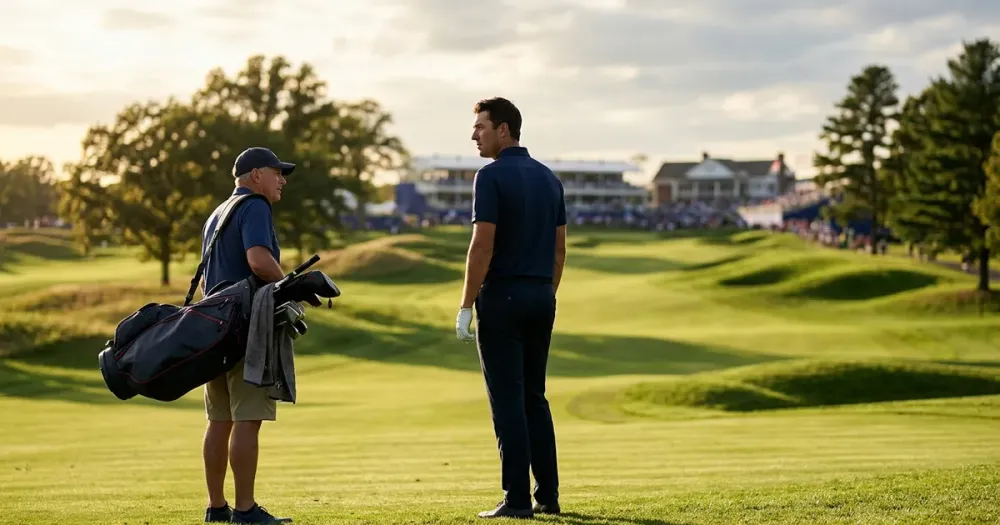
Scottie Scheffler, the world’s top-ranked golfer, has dominated stroke play for years but remains an enigma in match-play formats like the Ryder Cup. Behind the scenes at Medinah Country Club during the 2026 Presidents Cup, Scheffler voiced a rare frustration—not about his own record but about damaging rumors clouding the U.S. Ryder Cup team’s cohesion. These off-course narratives, including the infamous story about Patrick Cantlay not wearing his hat and whispers of a divided American team room, have quietly chipped away at trust and morale.
Why does this matter? Because the Ryder Cup is more than just a golf tournament; it’s a crucible where national pride and team chemistry collide. Scheffler’s struggle to translate his stroke-play dominance into match-play success has been magnified by these false stories. The fallout affects not only his performance but also the broader perception of American team golf as it heads into the 2026 Ryder Cup at Adare Manor.
Scottie Scheffler’s Match-Play Puzzle
Scheffler’s record in stroke play is exceptional, making him the defining figure in golf over the past four years. Yet, his match-play stats tell a different story. At the Presidents Cup, he holds a 3-5-1 overall record, with a particularly tough time in foursomes (1-3-1) and singles (0-2-1). His Ryder Cup results echo this pattern: 3-6-3 overall, and a winless 0-4-0 mark in foursomes. These numbers contrast sharply with his stroke-play success and suggest a challenge in adapting to the pressures and dynamics of team formats.
The Weight of False Narratives
Scheffler pinpointed the most frustrating part—not his results, but the untrue stories that swirl around the U.S. team. He specifically mentioned rumors about Patrick Cantlay’s hat controversy and the perception that the Americans meet in separate rooms, implying a fractured squad. “It’s something for us that can be very frustrating at times because it’s very much untrue,” Scheffler said.
These narratives gained traction following disappointing Ryder Cup performances in 2023 and 2025, where the U.S. team struggled under intense European pressure. Despite the U.S. Presidents Cup team’s commanding history—winning 10 of 11 events—those Ryder Cup shadows linger, coloring fan and media perceptions.
Presidents Cup: A Platform for Redemption
While the Ryder Cup struggles have fueled doubt, the Presidents Cup offers a contrasting narrative. The Americans’ dominance in this event has been steady, and many view it as a laboratory to rebuild American team unity. The Presidents Cup’s role in preparing players for Ryder Cup pressure is increasingly emphasized, with hopes it can establish continuity among captains and players, and foster a winning blueprint for future U.S. team golf.
Partner Dynamics and Pressure
One underappreciated challenge Scheffler faces is finding the right partner in team formats. U.S. captain Brandt Snedeker acknowledged the difficulty: "There’s a feeling of I’m letting him down. He’s the best player in the world, so no matter what I do isn’t going to be good enough." Since 2023, Scheffler has played with seven different partners, reflecting an ongoing search for chemistry.
Scheffler himself recognizes that his hypercompetitive nature may contribute to the problem. He admitted he might be trying too hard, which can disrupt the delicate balance required in best-ball and alternate-shot formats. "Trying less would be really important," he said, acknowledging the challenge of managing intensity while playing for a partner.
Scottie Scheffler Ryder Cup Team Narratives 2026: What Lies Ahead
As the 2026 Ryder Cup approaches at Adare Manor, the questions surrounding Scheffler’s match-play record, team chemistry, and partner fit will intensify. Scheffler’s frustration over false narratives highlights a deeper issue: how perception can shape team dynamics just as much as performance. The U.S. team’s ability to harness the Presidents Cup momentum, dispel damaging rumors, and build genuine cohesion could determine whether Scheffler’s Ryder Cup legacy finally matches his stroke-play dominance.
What this means is that fans and analysts should look beyond headlines and statistics to understand the psychological and social layers influencing these team events. The false narratives don’t just misrepresent reality—they risk undermining the very unity the U.S. team needs to reclaim Ryder Cup glory. How the American squad addresses these challenges in the coming months will be critical.
Looking ahead, all eyes will be on Scheffler and the U.S. team’s performance at upcoming team events, including the next Presidents Cup and Ryder Cup selections. Will the World No. 1 find the right balance and partnership to thrive under match-play pressure? The answers will shape American golf’s team story for years to come. For a broader view, explore our coverage of PGA Tour news and results.
Source: as reported by All The Golf
All facts and quotes are credited to their originating outlets. Learn more about our sourcing policy.