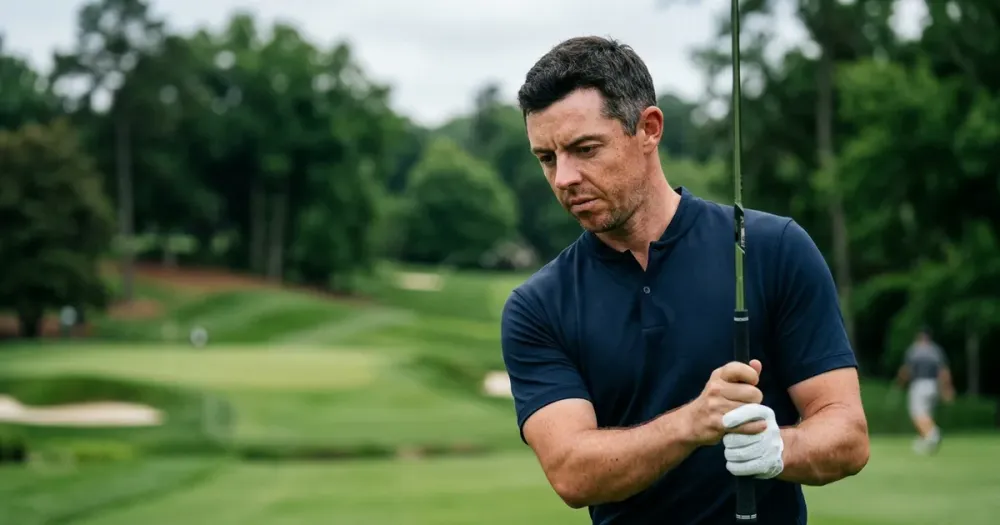
At Bellerive Country Club, Rory McIlroy embarked on a rigorous two-day practice session in late August 2026, hitting 313 balls under the watchful eyes of longtime swing coach Michael Bannon and caddie Harry Diamond. This intense grind wasn’t about chasing immediate tournament glory but addressing deeper swing issues that had crept in over recent months. McIlroy’s commitment to fixing these ingrained problems highlights the painstaking journey even elite golfers face to maintain their edge.
Facing the Reality of Bad Habits
McIlroy openly admitted during a pre-tournament press conference that his swing had developed some detrimental habits over the past few months. “Yeah, I’ve definitely gotten into some bad habits in my golf swing over the past few months,” he said. The nature of tournament golf often forces players to rely more on instinct and shot-making rather than technical precision, which can cause subtle flaws to become deeply embedded. McIlroy’s experience reflects this tension between instinctive play and mechanical consistency, a challenge familiar to many top professionals.
Focused Practice: Reps and Reps at Bellerive
Responding to this challenge, McIlroy dedicated himself to a focused practice regimen with Bannon and Diamond. After working at home in Florida on Monday, he spent Tuesday and Wednesday at Bellerive hitting over 300 balls. The volume of reps underscores how elite players must drill fundamentals relentlessly to reprogram muscle memory. McIlroy emphasized the difficulty of transferring practice-range improvements to actual course play, noting, “It’s hard to do that for three hours on the range and then try to go on the golf course and play like that as well.”
Grip Tweaks as a Tool, Not a Cure-All
Part of McIlroy’s process involved experimenting with grip feel to help locate his hands correctly during the backswing. He described modifying a lob wedge and a 7-iron with Flat Cat putter grips rotated at a 45-degree angle. This setup aims to position his right hand on the flat part of the grip halfway back, a spot McIlroy identifies as ideal for his swing. “It just helps my right arm work better,” he explained, emphasizing that the change supports right arm structure and gives him better control over the club.
It’s important to see these grip modifications not as a wholesale swing overhaul or a guaranteed fix but as part of a broader, ongoing effort to solidify fundamentals. McIlroy’s approach reveals how nuanced and experimental elite swing work can be, blending feel with mechanics.
Progress, Not Perfection, on the Scorecard
While McIlroy’s swing work was underway, his tournament results showed signs of improvement but did not tell the full story. One week after finishing 66th out of 68 players at the FedEx St. Jude Championship, he opened the BMW Championship with a six-under 64, tying for the lead. The following day, he shot 69 and entered the third round five strokes behind the leader. These scores suggest that his hard practice is paying dividends, though the deeper goal remains embedding consistent swing mechanics for the long term.
Why Rory McIlroy’s Swing Practice Matters Now
McIlroy’s recent grind at Bellerive sheds light on the relentless work behind elite golf performance. It’s a reminder that even champions must confront and fix subtle swing flaws through meticulous practice and coaching. His willingness to experiment with grips and commit to high-volume reps demonstrates a level of discipline that often goes unseen but is crucial for maintaining competitiveness on the PGA Tour.
According to All The Golf, this phase of McIlroy’s swing restoration is less about instant results and more about laying a foundation for sustained success.
What to Watch Next
The coming weeks will test whether McIlroy’s swing adjustments hold up under tournament pressure. Observers should track his performance in upcoming PGA Tour events and monitor changes in his ball striking consistency and scoring stability. McIlroy’s ability to integrate these practice gains into competitive rounds will be the true measure of his recent work’s effectiveness.
This cycle of swing refinement is a familiar but critical pattern for pros aiming to stay at the top in a sport where tiny mechanical improvements can yield significant competitive advantages.
What this means: McIlroy’s practice routine in August 2026 highlights the physical and mental effort required to overcome entrenched swing habits. It shows how elite players use targeted grip adjustments and high-volume reps to recalibrate their mechanics, a process that is gradual and demands patience. For a broader view, explore our coverage of PGA Tour player profiles and rankings.
Source: according to All The Golf
All facts and quotes are credited to their originating outlets. Learn more about our sourcing policy.