Quick Tip:
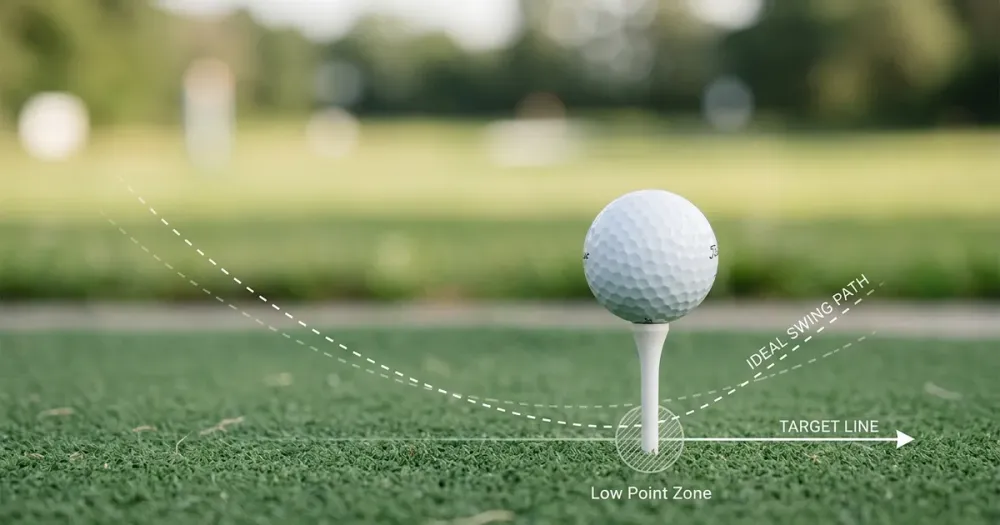
- Your low point must be just past the ball for clean contact—early low points cause topping.
- Keep your hands ahead of the ball at impact to move the low point forward.
- Use a tee peg drill to train your swing to hit after the ball, not before.
The Mistake: Early Low Point Causes Topping
If you repeatedly top the ball, you’re battling your low point. Instead of the club reaching its lowest position just after the ball, it happens too soon. That means your clubhead is already rising as it meets the ball, catching the equator instead of striking cleanly. This is the classic topping problem that frustrates many amateurs.
Why does this happen? Most golfers instinctively try to "help" the ball up. They scoop at it or lean backward, which shifts the low point behind the ball. The result? Poor contact and lost distance.
Why It Happens: Biomechanics Behind the Scoop
The scoop occurs because the hands trail behind the ball at impact, flattening the swing arc too early. When the club’s low point falls behind the ball, the clubface starts to rise prematurely. This is a natural reaction to avoid hitting the ground, but it compromises ball striking.
To fix it, you need to reverse that motion by moving your low point forward. That means your hands must lead the clubhead through impact, creating a forward shaft lean. This forward shaft lean ensures that the clubhead bottoms out just after the ball, delivering a crisp strike.
The Fix: Step-by-Step Low Point Control
Step 1: At the top of your backswing, check that your trail elbow is positioned below your lead elbow. This slight drop helps you maintain a descending angle on the downswing.
Step 2: On the downswing, focus on keeping your hands ahead of the ball at impact. Imagine the shaft leaning forward so the leading edge points slightly downward when striking the ball.
Step 3: Shift your body laterally toward the target during transition. This subtle weight shift moves your center of mass forward, helping the club bottom out after the ball.
Step 4: Synchronize your leg action by rising slightly through impact. This prevents the club from digging into the turf and maintains the correct low point.
The Drill: Tee Peg Practice for Low Point Precision
James Jankowski recommends a simple yet effective drill to ingrain this low point timing. Insert a tee peg into the ground about an inch ahead of your normal ball position—the spot where your club should bottom out.
During practice swings, aim to clip the tee after striking the ball cleanly. This trains your hands to lead and your low point to move forward naturally. Over time, this drill rewires your swing to avoid early low points and topping.
Why This Matters: Control the Low Point, Control Your Game
Mastering how to improve low point in golf swing is the secret many amateurs overlook. Instead of chasing power or obsessing over grip, controlling where your club bottoms out transforms consistency. Players like Justin Thomas maintain a forward shaft lean and lateral shift that keeps their low point just after the ball, enabling precise ball striking under pressure.
Understanding and training this element reduces fat and topped shots, improves launch conditions, and ultimately lowers scores. The low point is the fulcrum of impact quality. Get it right, and the rest of your swing falls into place.
For amateurs serious about improvement, the tee peg drill combined with focus on hand position and lateral shift is a straightforward path to better ball striking.
All The Golf reported these insights from PGA Pro James Jankowski, emphasizing how this less glamorous swing detail carries huge payoff.
What to Watch Next: As you head to your next range session or round, pay close attention to low point timing. The coming weeks offer a chance to measure progress by tracking your contact quality and consistency. Watch how small tweaks in your hands’ position and body shift change your ball flight and scoring. Jennifer Kupchos Clutch Putting adds context worth exploring for readers following this topic closely. Charley Hulls Putting Struggles adds context worth exploring for readers following this topic closely. For a broader view, explore our coverage of golf tips and game improvement guides.
All facts and quotes are credited to their originating outlets. Learn more about our sourcing policy.