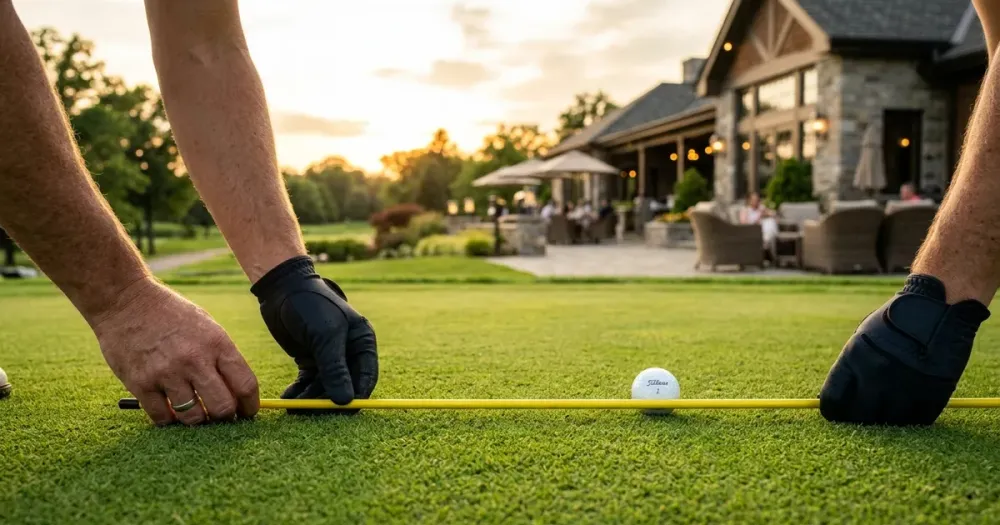
Quick Tip:
- Don’t stand behind the ball and point directly at the distant target—this causes parallax error.
- Align your body parallel to an intermediate marker lined up with your target.
- Use alignment sticks or a visible marker close to you to check and train your aim.
The Mistake: Aiming from Behind the Ball Causes Misalignment
Why It Happens: Understanding the Parallax Paradox in Golf
The parallax paradox is a common visual effect where objects appear shifted based on the observer’s angle of view. In golf, when you stand behind the ball and look at a target farther downrange, your eyes see the target and the ball from different angles. This disconnect means the line you think you’re aiming along isn’t where your clubface will actually send the ball. Coach Josh Mayo explains this happens because your perspective shifts between the ball and target, causing a misalignment that amateurs rarely detect on their own.
The Fix: Step-by-Step Alignment Adjustments
Correcting this requires a deliberate change in how you pick your aiming line and set up your body. Follow these steps to recalibrate your aim:
- Place an alignment stick or marker on the ground or a base in line with your distant target but close enough to see clearly when addressing the ball.
- Stand behind the stick and adjust it left or right until you feel it points exactly at your target. This is your true target line as seen from ground level.
- Address the ball with your body aligned parallel to this stick—not directly pointing at the distant target. Your feet, hips, and shoulders should form a line with the stick.
- Focus on the alignment stick while setting your clubface so it points directly along this corrected line, ensuring your swing path matches the intended target.
- Visualize the ball traveling over the stick line toward your distant target, correcting for the parallax-induced misperception.
Josh Mayo points out that aligning parallel to a closer marker helps golfers focus on their clubface and swing path rather than relying on a shifting distant target view. This approach minimizes parallax error and dramatically improves shot direction.
The Drill: Training Your Eye and Body for Accurate Aim
To build this into your routine, try this simple drill at the range:
- Set up an alignment stick or a visible object (like a colored patch or a foam noodle) in line with your target at a few feet in front of your ball.
- Stand behind the stick and confirm it points at your target by moving it left or right until it aligns perfectly.
- Address the ball with your body parallel to the stick, then swing aiming to hit the stick’s line.
- Repeat multiple shots with the same club and target to develop muscle memory.
- Vary clubs and targets to challenge your perception and reinforce the new alignment habit.
Tour players like Rory McIlroy use similar alignment checks to ensure their setup matches their intended target line, proving that mastering aim starts with visual correction. Incorporating this drill into your practice will help you build a reliable pre-shot routine that accounts for the parallax paradox.
Why This Matters Now
Many golfers waste strokes due to invisible alignment errors caused by parallax. Understanding and fixing this can unlock immediate improvement in shot accuracy without complex swing changes. This is especially valuable for amateurs who struggle to consistently hit fairways or greens despite solid contact. By mastering parallax paradox golf alignment tips, you take control of your aim and shot direction starting today.
What this means: Your brain and eyes need a closer reference point to align properly. Why it matters: Without this, good swings still miss the target. How it works: The closer marker negates the visual angle difference that causes parallax error.
What to watch next: Try this drill at your next practice session and track your shot dispersion. The upcoming golf rankings and your scoring will reflect any alignment improvements. Also, watch for how your setup routine adapts during your next round to reduce frustrating misses and boost confidence. For a broader view, explore our coverage of golf tips and game improvement guides.
Source: as reported by Golf Monthly
All facts and quotes are credited to their originating outlets. Learn more about our sourcing policy.