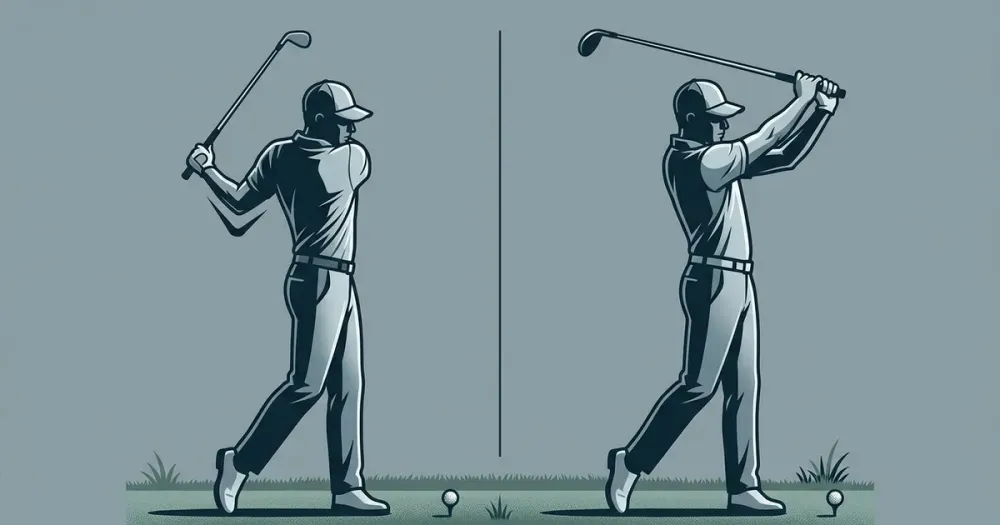
Quick Tip:
- Watch your lead elbow: it should stay straight and close to your body through impact.
- At the top of your backswing, keep your trail elbow below your lead elbow, not flared out.
- Practice punch shots with a club pointing at your target to train correct arm and club positions.
The Mistake: What Is the Chicken Wing?
One of the most common faults stealing distance from golfers is the "chicken wing". This occurs when your lead arm’s elbow bends prematurely and flares out during the downswing and at impact. Instead of your lead arm staying connected and straight, the elbow points away from your body, causing you to "throw" the club rather than swing it.
The immediate result? A loss of clubhead speed and power. The clubface tends to slice across the ball on an out-to-in path, robbing you of distance and control. Imagine trying to throw a bucket of water over a dirty car: if your elbow flares like a chicken wing, the water splashes everywhere instead of reaching the target. That’s the physical reality of this swing fault.
Why It Happens: The Biomechanics Behind the Power Leak
The chicken wing breaks the connection between your lead arm and torso, short-circuiting the kinetic chain—the seamless energy transfer from your ground up through your body and into the clubhead. When your lead elbow bends and moves away from your body, it disconnects your arms from your core rotation.
Without this connection, your swing loses efficiency. Instead of harnessing rotational power, you rely on your arms alone, which can’t generate the same clubhead speed. This leads to weak contact, inconsistent ball flight, and less distance off the tee.
The Fix: John Jacob’s Step-by-Step Correction
John Jacob, a seasoned golf coach, breaks down the fix into precise body and club positions. Follow these steps to regain your power and control:
1. Trail Elbow Position at the Top: At the top of your backswing, your trail elbow (right elbow for right-handers) should be positioned below your lead elbow. This keeps your arms on a level plane and sets up a connected downswing.
2. Lead Elbow Tracking Close: During the downswing and through impact, your lead elbow should stay close to your torso, avoiding any flaring out. This maintains the arm-body connection essential for power.
3. Clubface Alignment: At impact, the clubface should point through the target line rather than across it. This requires a controlled path and prevents slicing caused by the chicken wing.
4. Mirror the Follow-Through: After impact, your lead arm and club should extend fully, mirroring the connected position you held at the top of the swing. This ensures you’ve maintained connection throughout.
The Drill: Punch Shots to Retrain Your Swing
Start with punch shots to ingrain the correct positions:
Set up with a short backswing and focus on keeping your trail elbow below your lead elbow at the top. As you swing through, punch the ball with a shortened follow-through, making sure the club points toward your target at impact. This drill helps you feel the proper arm positions and control the clubface.
Repeat this slowly at first, using a mirror if possible, to check that your lead elbow does not flare out. Over time, this will build muscle memory and eliminate the chicken wing.
How Fixing the Chicken Wing Boosts Your Game
By correcting this fault, you restore the connection between your arms and torso. This leads to a more powerful and efficient swing, increasing clubhead speed and driving distance. Golfers who fix the chicken wing often see their ball flight straighten and gain 10 to 20 yards off the tee.
John Jacob’s advice, as reported by Golf Monthly, distills decades of teaching into actionable steps that any golfer can apply. The key is focusing on precise body and club positions rather than vague feel cues.
What to Watch Next
After mastering the punch shot drill, take your corrected swing to the range and work on full swings maintaining these arm positions. Track your driving distance and ball flight consistency over the next few weeks. Your next real test will be the upcoming local tournament or your next round on a challenging golf course where distance off the tee matters most.
Consistency and connection in your swing will unlock not only distance but lower scores and more enjoyment on the course. For a broader view, explore our coverage of golf tips and game improvement guides.
Source: as reported by Golf Monthly
All facts and quotes are credited to their originating outlets. Learn more about our sourcing policy.